The United States and Iran signed a memorandum of understanding that halted recent military operations, reopened the Strait of Hormuz to commercial shipping, lifted blockades, extended a ceasefire to Lebanon, and established a 60-day window for further nuclear negotiations. Iranian missiles and stockpiles of enriched uranium remain intact. The reconvened Sanhedrin issued a psak din on 30 Sivan 5786 condemning the agreement in strong terms. The court drew a parallel to the pact Ahasuerus granted Haman and called on Jews worldwide to fast, pray, and repent for its annulment. This response reflects deep concern for Jewish survival amid ongoing threats from Iran and its proxies.
Where Authority Must Begin
Where does authentic Torah authority begin when enemies seek advantage through diplomacy? The Sages provide the answer in the proper sequence of restoration.
“This month shall be for you the beginning of months; it shall be the first month of the year for you” (Exodus 12:2).
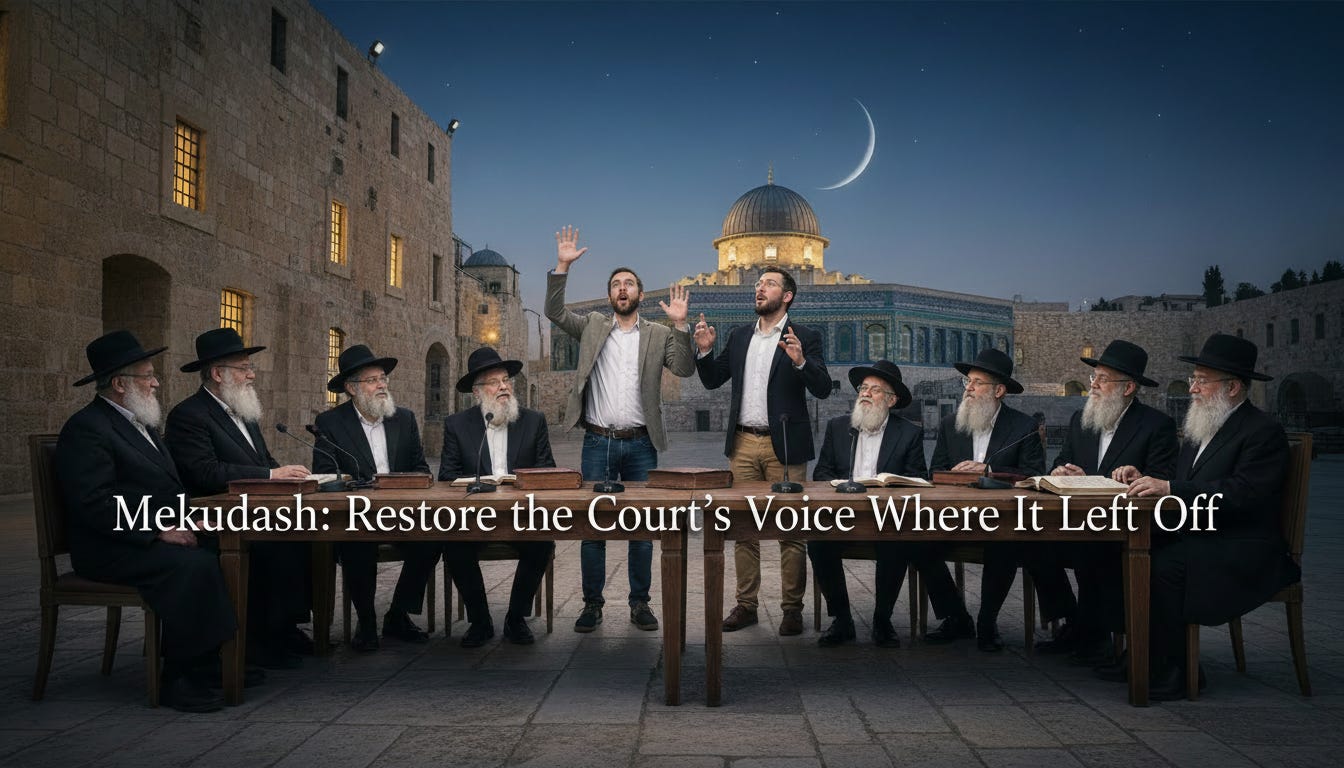
The Great Sanhedrin once convened to receive testimony from at least two reliable witnesses who had sighted the chodesh, the new moon. After examination, the court declared Mekudash, sanctifying the month and setting the calendar for the entire nation. This act governed offerings, festivals, and the rhythm of national life. It was not a minor administrative function but the court’s voice establishing order from the Torah itself. Dispersion and persecution later led to reliance on mathematical calculation under Hillel II. The reconvened Sanhedrin has already formed a special beit din to receive and practice with new moon testimony. Resuming public declaration of Mekudash is the step that picks up where the historical court left off and builds the foundation for fuller authority.
The Six Rulings in Halachic Context
The Sanhedrin’s six rulings in the recent psak din address the memorandum’s terms with halachic clarity. Each deserves examination in light of Torah sources and the current reality of incomplete rulership. The Sages consistently taught that protection of Eretz Yisrael and its people overrides diplomatic arrangements that endanger life. Rambam and earlier authorities outline the court’s role in guiding the nation, especially when kingship or full executive structures are not yet firmly in place.
1. Repentance and Prayer
The ruling calls for assemblies of ta’anit, fasting, repentance, soul-searching, prayer, and outcry to annul the decree, alongside gratitude for miracles already granted in the conflict. This stands squarely within the court’s mandate. The Sages instituted public fasts in times of communal danger, as seen in Talmudic tractates on ta’anit. Gratitude for divine intervention echoes biblical responses to deliverance. No overreach here. This is core religious leadership.
2. Territorial Integrity
The court declared that every clause involving Israeli withdrawal from any portion of Eretz Yisrael is null and void. Conquered land must remain in Jewish possession, withdrawal is forbidden, and settlement is obligatory. This aligns with the Torah’s commandments on inheritance of the Land. The Sages viewed possession of Eretz Yisrael as a binding halachic imperative, not subject to foreign agreements. In the absence of a king to enforce borders, the court properly reminds the nation of this foundational duty.
3. Leadership and Victory
The ruling requires the Prime Minister to fulfill the will of the people according to Torah by achieving complete victory in Lebanon, Gaza, and against Iran, enabling settlement in conquered territories. Historical precedent shows the Sanhedrin advising or authorizing military action in defense of the nation. When executive leadership faces existential threats, the court’s voice urging total victory follows the Sages’ emphasis on destroying those who seek to destroy Israel. This is guidance, not usurpation.
4. Right to Self-Defense
The Sanhedrin affirmed that any clause limiting Israel’s right to self-defense is null and void. The State has the halachic and moral duty to defend itself and destroy enemies, particularly Hezbollah, termed Chizb-El-Satan. Self-defense is a fundamental Torah principle. The Sages never required a court to remain silent when enemies arm for annihilation. This ruling strengthens resolve at a critical hour.
5. International Waters and Navigation
The court ruled that clauses granting the Revolutionary Guards special rights in international waters are null and void. Any entity closing an international waterway becomes an enemy of humanity, and nations must confront it. While the ancient Sanhedrin did not issue detailed global naval policy, it did address threats to Jewish security and freedom of movement for the people. In an era when shipping lanes fund terrorism affecting Israel, this extension flows from the duty to prevent harm. It highlights the need for stronger centralized rulership to carry such declarations into full effect.
6. Legitimacy of the Regime
The Sanhedrin declared the Revolutionary Guards illegitimate following their actions against their own citizens and called for naval siege and destruction of supporting infrastructure until the regime falls. This draws on Torah laws of siege warfare against enemies and the imperative to remove threats. The Sages authorized measures to protect the nation from regimes bent on destruction. The call reflects the vacuum left by incomplete restoration of the Nasi and Davidic-aligned leadership. It is understandable in context even as fuller structures would refine execution.
The Path of Restoration
The current Sanhedrin operates through semicha renewed via Rambam’s model of consensus among sages in Eretz Yisrael. Rabbi Tzvi Eidan served as interim Nasi, followed by Rabbi Adin Steinsaltz in a transitional capacity. This process follows established halacha for restoration before the full arrival of Mashiach. It is a developing effort by committed sages, not a completed sovereign body. The lack of universal acceptance and a firmly seated Nasi from the line of David explains why some rulings extend into areas traditionally shared with executive authority. The solution is not to weaken the court’s voice but to strengthen the entire system.
Mekudash will resonate around the world. When the court publicly sanctifies the new moon through witnesses, Jews and supporters of Israel will recognize a return to biblical order. Nations will either draw near to a Jerusalem guided by Torah institutions or separate themselves. The mocking that greets broader decrees will diminish as the court demonstrates competence on foundational matters. Acceptance in Israel will grow, pressuring formal government structures to align with halacha. Outsiders, whether in distant cities or aligned with opposing causes, hold no vote in this internal restoration. The nation that prioritizes Torah sets the direction.
I, Yosef Eitan, desire the full restoration of the Sanhedrin, its proper seating in the Lishkat HaGazit, and the rebuilding of the Temple in my days. I prayerfully request the nation join me and all who seek Jerusalem as a light to the nations soon and in our days. Let the witnesses come forward. Let the court declare Mekudash. Let the shift to proper rulership from the line of David begin in earnest. The path forward starts where the Sages left off. The time to act is now.
Join our Online Community at PerfectingTheWorld.com